The mining industry is moving beyond cautious experimentation with digital technologies and increasingly embedding advanced software, automation and artificial intelligence into everyday operations.
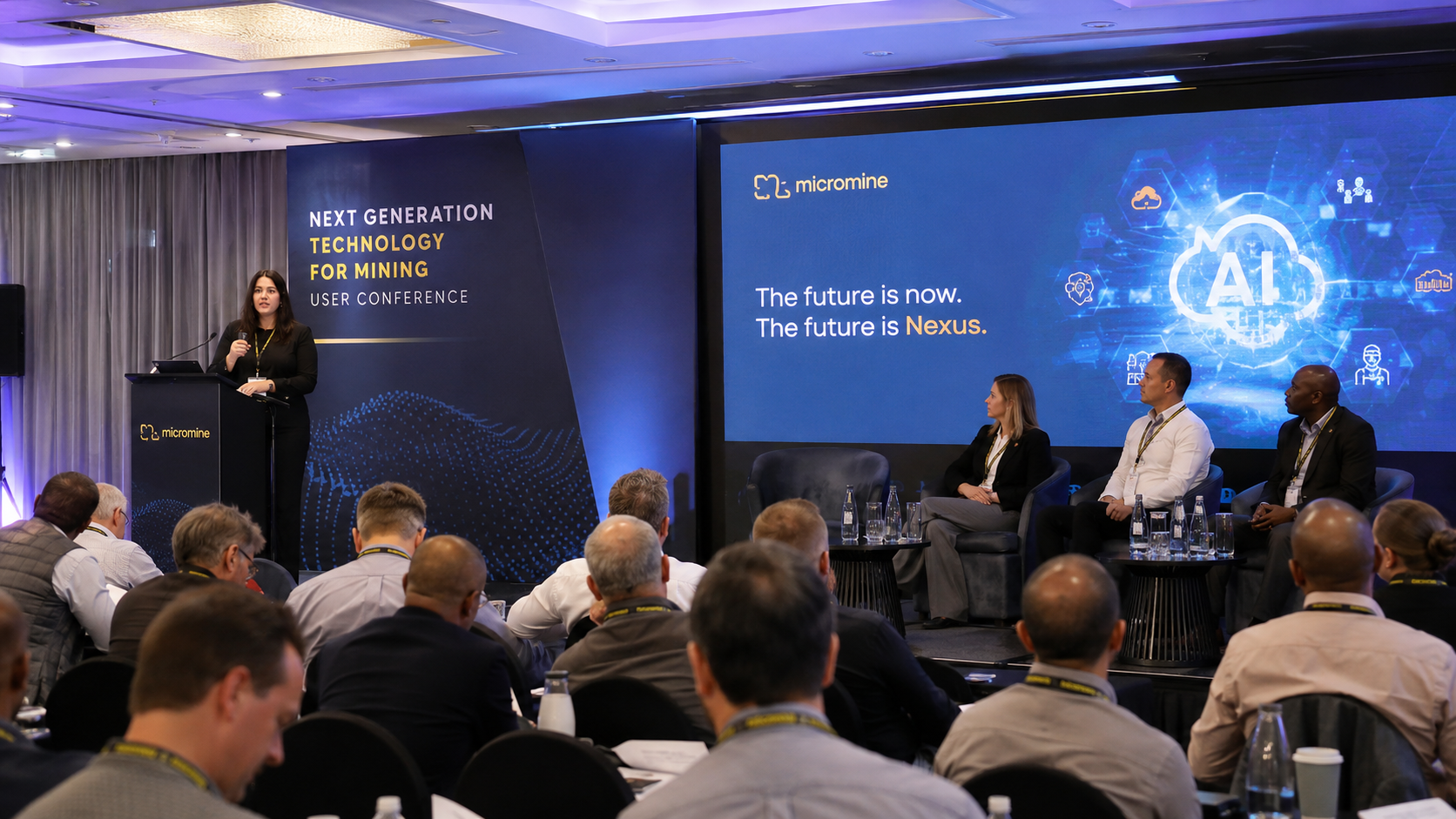
This was one of the strongest messages to emerge from the Next Generation Technology for Mining User Conference, taking place from 5–6 August 2026, where industry professionals, technology specialists and mining practitioners gathered to examine how digital tools are transforming operations from geology and resource modelling through to mine planning, scheduling and production.
The first day of the conference presented a clear picture of an industry increasingly focused on practical results, faster decision-making and measurable operational improvements rather than technology adoption for its own sake.
From geology to production
Opening the discussions, Micromine General Manager for Africa, Middle East and Europe Michelle Beetar highlighted the important role that geologists continue to play in the digital transformation of mining.
“75% of the people using our software includes geologists and that tells you where the transformation is happening,” Beetar said.
She explained that digital transformation is increasingly connecting traditionally separate stages of the mining process, allowing information generated during geological exploration and modelling to flow more effectively into planning and production.
According to Beetar, both open-pit and underground mining operations are being reshaped by connected technologies that bring data closer to the point where decisions are made.
“From geology to production we are seeing a complete shift and Nexus is about bringing artificial intelligence and automation into that flow in a practical way,” she said.
The emphasis on practicality was a recurring theme throughout the conference. Rather than viewing artificial intelligence and automation as standalone technologies, discussions focused on how they can be incorporated into existing workflows to improve productivity, reduce uncertainty and support better operational decisions.
Managing uncertainty in mineral resources
The importance of reliable geological modelling was explored further during a technical presentation by Paula Mierzwa of the Addison Group, titled ‘How Certain Are Our Ounces’.
The session examined the challenge of understanding uncertainty in mineral resource estimates and the role conditional simulation can play in improving confidence in geological models.
Mierzwa explored the relationship between simulation and traditional kriging approaches, stressing that the objective is not necessarily to select one method over another, but to understand how different modelling techniques can support better decisions.
“The conversation is not about choosing one over the other but understanding how each method supports better decision making,” Mierzwa said.
Her presentation placed particular emphasis on risk management. In mining, decisions based on resource estimates can have significant implications for mine design, investment, production schedules and long-term economics.
“If we can simulate outcomes before we commit in the field we reduce uncertainty and improve confidence across the value chain,” she added.
Case studies presented during the session demonstrated how improved modelling approaches can contribute to more reliable resource estimates, allowing mining companies to better understand geological variability before committing significant capital and operational resources.
Digital mine planning delivers faster results
The discussion then moved from geological modelling into practical mine planning, with Abdul Momade of Vulcan Mozambique sharing experience from the Moatize coal mine.
Speaking during a session on the digital mine planning journey using Micromine Spry, Momade explained how the operation has used technology to address planning challenges and improve the speed at which different mining scenarios can be evaluated.
“We needed faster planning and more innovative solutions to address the limitations we face in mining and this is where the system is delivering,” Momade said.
One of the key benefits highlighted was the ability to automate elements of scheduling while generating scenarios more rapidly.
For mining operations, the ability to test multiple scenarios quickly can be particularly valuable when dealing with changing geological conditions, equipment availability, production targets and operational constraints.
“The flexibility and robustness of the software allow us to optimise constraints and that is translating into real business impact and increased production,” Momade explained.
The experience at Moatize illustrates a broader shift in mine planning, where digital platforms are increasingly being used not simply to create plans, but to evaluate alternatives and identify the most effective path forward.
AngloGold Ashanti sees major scheduling gains
The benefits of digital scheduling were further demonstrated by Jonathan Dzah of AngloGold Ashanti, who presented on the results achieved through the use of Micromine Alastri.
One of the most significant outcomes has been a substantial reduction in scheduling time.
“We have reduced scheduling time by around sixty percent and that is a major shift for us,” Dzah said.
However, the benefits extend beyond simply completing schedules faster. Dzah highlighted improvements in collaboration, visualisation and communication between planning teams and operational personnel.
“Better visualisation is helping us bridge the gap between what happens in the office and what happens on the ground,” he said.
This connection between planning and execution is becoming increasingly important as mines seek to improve operational performance.
A mine plan may be technically sound, but its value ultimately depends on how effectively it can be translated into action at the operational level.
Dzah also pointed to the increasing use of historical operational data to test scenarios and support planning decisions.
“We are now using historical data to test scenarios more rapidly and that flexibility is improving the quality of our decisions,” he said.
The ability to combine historical information with current operational conditions creates opportunities for mining companies to move towards more dynamic and responsive planning processes.
Connected technologies creating a more responsive mine
The conference also expanded beyond individual software solutions to examine the broader concept of the connected mine.
Presentations covering integrated platforms such as Fast2Mine, Advance, Pitram and Motion Metrics demonstrated how different technologies can contribute to a more connected operating environment.
The increasing integration of these systems is helping mining companies improve visibility across their operations, strengthen safety oversight and enhance operational control.
Rather than operating as isolated digital tools, connected systems can allow information to move between different parts of the mining value chain.
This has the potential to strengthen the relationship between geological modelling, mine planning, scheduling and execution, allowing operational teams to respond more quickly when conditions change.
Moving from digital experimentation to measurable value
Across the first day of the conference, a consistent message emerged: mining companies are increasingly moving beyond digital experimentation and towards technologies that deliver measurable operational value.
The focus is no longer simply on whether a mine has adopted artificial intelligence, automation or advanced modelling. The more important questions are whether these technologies are reducing planning time, improving resource confidence, increasing production, strengthening safety or enabling better use of existing data.
The examples presented at the conference provide practical evidence of this shift.
At AngloGold Ashanti, scheduling time has reportedly been reduced by around 60%. At Moatize, automated scheduling and rapid scenario generation are supporting production planning. In geological modelling, conditional simulation is being used to better understand uncertainty and strengthen confidence in resource estimates.
These examples demonstrate that the value of digital transformation ultimately comes from its ability to solve real operational challenges.
Artificial intelligence moves closer to the mine
Artificial intelligence was another important element of the discussions, particularly in relation to Micromine’s Nexus platform.
The growing application of AI in mining suggests that the technology is moving beyond experimentation and towards practical applications embedded within established workflows.
For mining companies, the potential value lies in using AI to help process increasingly complex datasets, identify patterns, automate repetitive tasks and support decision-making.
However, the conference discussions also reinforced the importance of connecting AI to reliable operational data and clearly defined business objectives.
AI cannot replace sound geological understanding, experienced mine planning or effective operational management. Instead, its potential lies in augmenting those capabilities and helping teams make faster and better-informed decisions.
The next generation of mining technology
As the conference continues, attention is expected to remain focused on how mining companies can scale these technologies across their operations and ensure that digital investments deliver sustainable value.
The first day has already demonstrated that the future of mining technology is increasingly centred on integration.
Geological data needs to connect with resource modelling. Resource models need to inform mine planning. Mine plans need to translate into effective schedules, while schedules need to connect with real-world execution.
When these processes operate within a connected digital environment, mining companies can gain greater visibility across the entire value chain.
For an industry facing pressure to improve productivity, manage costs, strengthen safety and maximise the value of increasingly complex mineral deposits, that connectivity could prove critical.
The message from the Next Generation Technology for Mining User Conference is therefore clear: digital transformation is no longer simply about adopting new technology. It is about connecting data, people and processes in ways that produce measurable improvements.
As artificial intelligence, advanced modelling, automation and integrated mine-planning platforms continue to evolve, mining companies that successfully embed these technologies into their daily operations will be better positioned to respond to changing conditions and unlock greater value from their assets.