

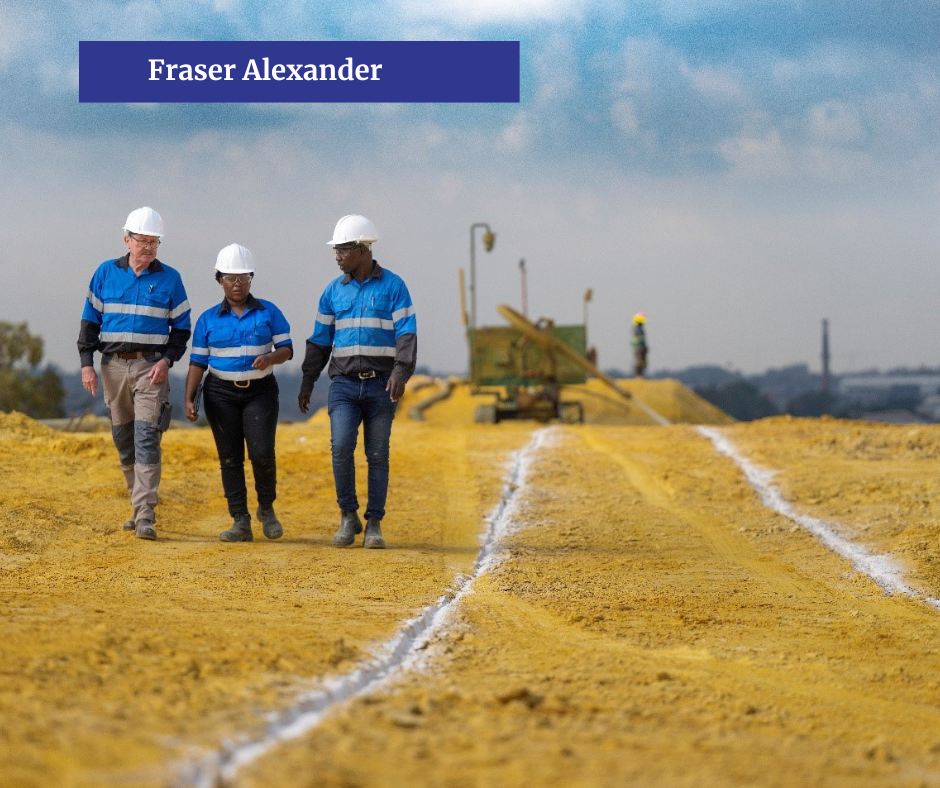
In the mining sector, true sustainability extends far beyond the extraction of minerals. It reaches into the lives, livelihoods and landscapes that surround every operation. For over a century, Fraser Alexander has built its reputation not only on technical excellence but also on a deep-rooted commitment to shared value and community empowerment.
From its beginnings in South Africa in 1912 to its growing footprint across Africa and beyond, including Zambia, the Democratic Republic of Congo (DRC), Ghana, Botswana, and Namibia as well as Brazil, Chile and India, Fraser Alexander has demonstrated that mining can be both profitable and purposeful. Its sustainability philosophy is guided by a robust Environmental, Social and Governance (ESG) framework that places people, planet and partnership at the center of every decision.
According to Bongani Buthelezi, Chief Operating Officer of Fraser Alexander, the company’s sustainability journey is anchored in innovation and responsibility. “We are fully committed to advancing a circular economy and achieving carbon neutrality by 2050,” he emphasized. To meet this ambitious goal, the company is actively reducing emissions through fleet upgrades, energy procurement reforms and close collaboration with suppliers. These initiatives reflect Fraser Alexander’s belief that environmental stewardship and operational efficiency must go hand in hand.
Beyond its technical operations in surface mining, deposition and water treatment, Fraser Alexander invests deeply in the well-being of the communities in which it operates. Its social development agenda is not charity-driven but collaboration-driven. It is designed to strengthen local economies, enhance livelihoods and build long-term resilience. Through employment creation, skills development and enterprise support, the company ensures that the benefits of mining extend far beyond the mine gate.
One of Fraser Alexander’s strongest social sustainability pillars lies in local content development. By sourcing services and supplies from local businesses, the company stimulates entrepreneurship and empowers regional economies. This approach has had a transformative impact, particularly in areas like Zambia and the DRC, where local industries are the lifeblood of rural livelihoods.
Capacity building is another cornerstone of Fraser Alexander’s approach. The company invests in training and upskilling local talent, ensuring that communities are not merely observers of mining projects but active participants and future leaders. The ripple effect of this investment is a more empowered workforce, one that continues contributing to national economies long after a project’s lifespan.
Health and safety remain non-negotiable values at Fraser Alexander. The company’s robust risk management systems ensure safe tailings facility operations and minimise environmental risks. By embedding a strong safety culture across all levels, Fraser Alexander protects not only its employees but also the communities and ecosystems surrounding its operations.
Importantly, the company’s social engagement is grounded in respect for local culture, environmental balance and the people who host its operations. Through consultation, listening, and inclusive decision-making, Fraser Alexander has earned lasting trust among clients, regulators, and community partners.
Its community investment initiatives extend to education, healthcare, enterprise support, and programs addressing gender-based violence, reflecting a holistic approach to social impact. In each region where it operates, the company seeks to create an enabling environment that promotes dignity, equality and opportunity.
For mining regions like Zambia and the DRC, where social expectations and environmental sensitivities are rapidly evolving, Fraser Alexander’s approach sets a powerful example in that sustainable mining is not about taking resources; it is about building futures.
As the global mining landscape continues to transform, one truth remains clear, sustainability cannot exist without social inclusion. Fraser Alexander continues to prove that communities are not stakeholders on the sidelines but partners at the very center of progress.


