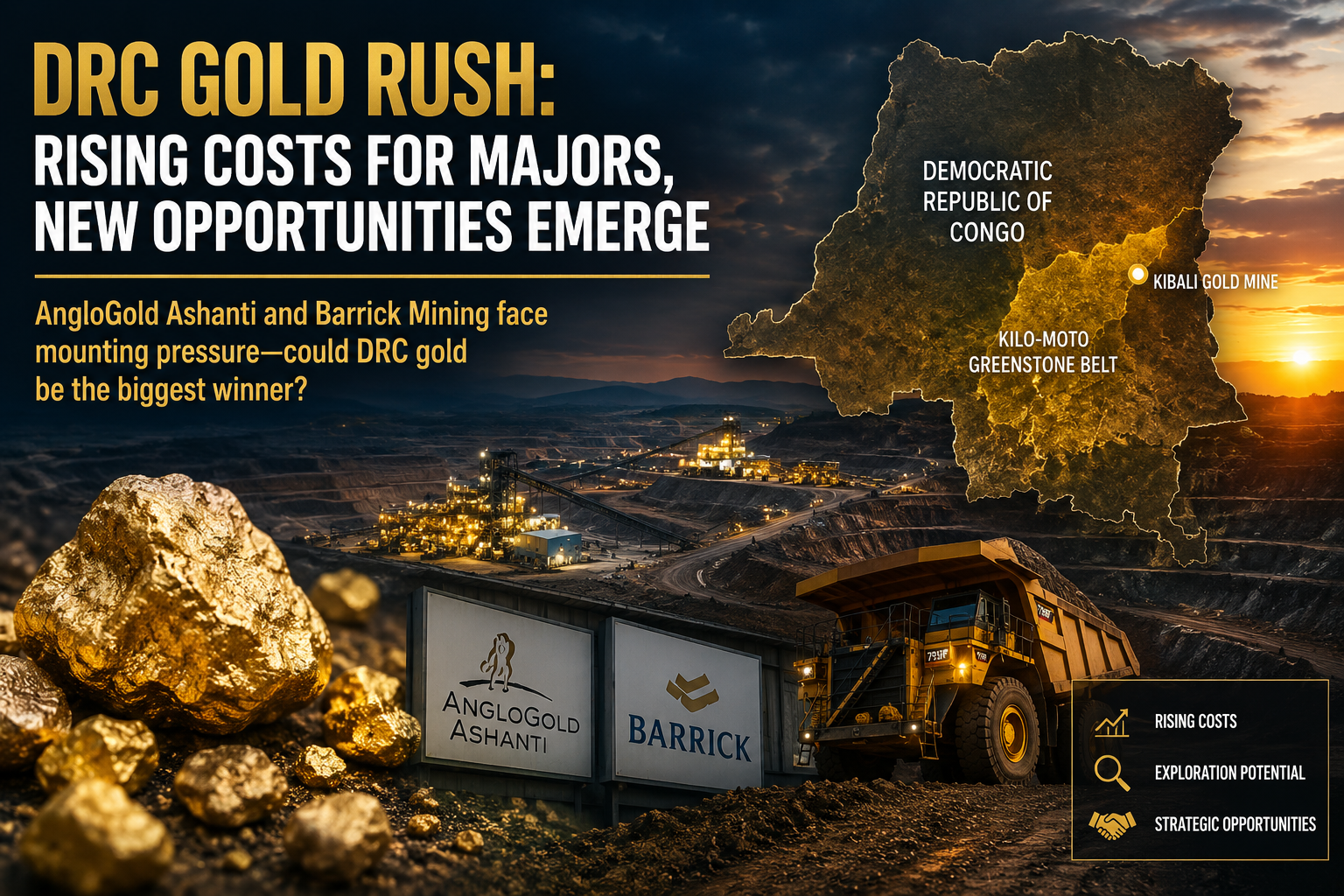
The Democratic Republic of Congo (DRC) continues to strengthen its position as one of Africa’s leading gold producers, but rising operating costs and evolving regulatory requirements are placing increasing pressure on established mining companies. At the same time, a new wave of exploration companies is seeking to unlock additional value within the country’s highly prospective Kilo-Moto Greenstone Belt, one of Africa’s richest gold-bearing regions.
Kibali Remains a Strategic Asset
The Kibali Gold Mine, jointly owned by Barrick Mining (45%), AngloGold Ashanti (45%), and the Congolese state-owned mining company SOKIMO (10%), remains one of Africa’s largest and highest-grade gold operations.
Despite its strong production profile, AngloGold Ashanti has reported declining output from its share of the mine over recent years. Production attributable to the company fell from more than 360,000 ounces in 2020 to approximately 309,000 ounces in 2024, with 2026 production guidance expected to range between 270,000 and 310,000 ounces.
While Kibali continues to benefit from reliable ore grades and modern infrastructure, profitability is increasingly being challenged by higher operating costs.
Rising Costs Impact Margins
Operating expenses at Kibali have risen steadily over the past several years.
According to AngloGold Ashanti’s reported figures, all-in sustaining costs (AISC) increased from approximately US$809 per ounce in 2020 to US$1,146 per ounce in 2024, with costs projected to rise further to between US$1,355 and US$1,460 per ounce in 2026.
The increase has been driven by several factors, including:
- Longer underground haulage distances as mining progresses deeper.
- Higher prices for imported equipment and consumables.
- Increased taxation and regulatory costs.
- Inflationary pressures affecting mining operations.
Although margins have narrowed, Kibali remains one of AngloGold Ashanti’s most valuable operations due to its high-grade resource base and long mine life.
Navigating Regulatory Change
As operator of the Kibali mine, Barrick Mining has also had to adapt to significant changes in the DRC’s mining legislation.
The introduction of the 2018 Congolese Mining Code increased government royalties on precious metals from 2.5% to 3.5% of gross revenue while introducing a 50% tax on extraordinary profits. The revised legislation also shortened the legal stability period protecting existing mining agreements from ten years to five years.
Despite these changes and occasional disputes over tax assessments, Barrick has continued investing heavily in the country.
Beyond mining activities, the company has invested in regional infrastructure, including maintaining more than 300 kilometres of roads, while supporting agricultural development and community programmes aimed at strengthening local livelihoods around the mine.
Exploration Activity Gains Momentum
While established producers focus on managing costs and maintaining production, junior exploration companies are increasingly targeting the broader Kilo-Moto Greenstone Belt, where significant discoveries remain possible.
One company attracting attention is DRC Gold, which is advancing exploration at its Giro Gold Project, located approximately 35 kilometres from the Kibali Gold Mine.
The project covers roughly 497 square kilometres and contains geological structures believed to be similar to those hosting Kibali’s world-class gold deposits.
Exploration work undertaken to date suggests the area has the potential to host significant gold mineralisation, with the company holding an option to acquire a 65% interest in the project.
Experienced Leadership
DRC Gold’s exploration programme is being led by respected geologist Dr Klaus Eckhof, who previously played a key role in the discovery of the Kibali Gold Mine.
His extensive experience in the DRC’s gold sector is viewed as an important advantage as the company seeks to define new resources within one of Africa’s most prospective gold belts.
Beyond Giro, DRC Gold has also assembled a broader exploration portfolio that includes:
- Nizi Gold Project within the historic Kilo-Moto Goldfield.
- Okote Gold Project in Ethiopia.
- Kabunda South Lithium Project in the DRC.
However, Giro remains the company’s flagship asset and primary exploration focus.
Potential Synergies
Industry observers note that Giro’s close proximity to Kibali could present strategic opportunities should commercially viable resources be confirmed.
Existing processing infrastructure at Kibali could potentially provide future development synergies, reducing capital requirements for any nearby discoveries.
This has fuelled speculation that successful exploration results could eventually attract interest from larger mining companies seeking to expand their resource base within the district.
Outlook for the DRC Gold Industry
Although operating costs are increasing for major producers, the Democratic Republic of Congo continues to offer significant long-term opportunities for gold investment.
The country remains home to vast underexplored greenstone belts with strong geological potential, while major operations such as Kibali continue to demonstrate the scale and quality of the nation’s mineral endowment.
As global demand for gold remains resilient amid economic uncertainty, both established producers and emerging explorers are expected to play an important role in shaping the next phase of growth in the DRC’s gold sector.